Introduction
Starting a workout routine for the first time is one of the best decisions you will ever make for your body, your energy levels, and your long-term health. It is also one of the most confusing — because the fitness industry has a vested interest in making it seem more complicated than it actually is.
This guide cuts through all of that. No complicated periodisation schemes, no expensive equipment requirements, no supplement protocols you need a degree to understand. Just the most effective beginner workout routine available, explained clearly, with everything you need to start today.
Whether you are training at home with minimal equipment or building your first home gym setup, this guide covers every variable — how many days to train, which exercises to do, how much weight to use, how to progress, and exactly what to eat and supplement to support your results.
Why Most Beginners Fail in the First 8 Weeks
Before getting into the programme itself it is worth understanding why most people who start a workout routine quit before seeing results — because avoiding these mistakes is just as important as the training itself.
Mistake 1 — Doing too much too soon. The most common beginner mistake is training 6 days per week out of motivation in week one, burning out by week three, and quitting entirely by week six. Your body needs recovery time to adapt. More is not better — consistent is better.
Mistake 2 — No progressive overload. If you lift the same weights for the same reps in every session your body has no reason to change. The single most important principle in any beginner workout routine is progressive overload — adding weight, reps, or difficulty over time.
Mistake 3 — Skipping the basics for advanced exercises. Social media makes advanced movements look impressive. Beginners need to master squats, deadlifts, push-ups, rows, and overhead press before touching anything more complex. The basics work — that is why they are still the basics after decades of fitness research.
Mistake 4 — No nutrition strategy. Training without eating enough protein is like building a house without cement. Your muscles are made of protein. If you do not eat enough your body cannot build or repair muscle tissue regardless of how hard you train
The Best Beginner Workout Routine — The 3 Day Full Body Programme
For beginners the most effective workout routine is a 3 day per week full body programme. Here is why this works better than anything else at this stage:
- Your nervous system needs to learn movement patterns before adding volume
- Full body sessions hit every muscle group three times per week — the optimal frequency for beginners
- 3 days leaves adequate recovery time between sessions
- It is sustainable — you can maintain this schedule for months without burnout
Training days: Monday, Wednesday, Friday — or any three non-consecutive days that fit your schedule.
Session duration: 45–60 minutes including warm-up.
The Warm-Up — 5 to 10 Minutes
Never skip your warm-up. A proper warm-up increases blood flow to working muscles, raises core temperature, activates the nervous system, and dramatically reduces injury risk — particularly for beginners whose movement patterns are still being established.
Warm-up protocol:
- 3 minutes light cardio — jumping jacks, skipping rope, or brisk walking
- 10 bodyweight squats
- 10 hip hinges (touch your toes and stand)
- 10 arm circles each direction
- 10 shoulder rotations
- 10 cat-cow stretches
Recommended: A weighted jump rope is the most effective warm-up tool for home gym beginners — 3 minutes of continuous skipping elevates heart rate, warms the ankles and calves, and improves coordination simultaneously.
Buy Locally In SA
👉 View Heavy Weighted Jump Rope on Mr Price Sport→
Buy Internationally
👉 View Heavy Weighted Jump Rope on Shein →
The Beginner Workout Routine — Exercise List
BLOCK A — Lower Body
Exercise 1 — Goblet Squat Sets: 3 | Reps: 10–12 | Rest: 90 seconds
The goblet squat is the best squat variation for beginners. Holding a dumbbell or kettlebell at your chest automatically creates the upright torso position that barbell squats require months of practice to achieve. It teaches the hip hinge, knee tracking, and depth simultaneously.
How to perform: Hold one dumbbell vertically at your chest with both hands. Feet shoulder width apart, toes slightly out. Sit your hips back and down until your thighs are parallel to the floor. Drive through your heels to stand. Keep your chest tall throughout.
Starting weight: Men — 8–12kg. Women — 4–8kg.
Buy Locally In SA
👉 View Adjustable Dumbbell Set on Mr Price Sport→ 👉 View Cast Iron Kettlebell on Mr Price Sport→
Buy Internationally
👉 View Adjustable Dumbbell Set on Shein → 👉 View Amazon Basics Cast Iron Kettlebell on Amazon →
Exercise 2 — Romanian Deadlift Sets: 3 | Reps: 10–12 | Rest: 90 seconds
The Romanian deadlift trains the posterior chain — hamstrings, glutes, and lower back — which are the muscles most South African desk workers have chronically underdeveloped. Strengthening these muscles improves posture, reduces lower back pain, and builds athletic power.
How to perform: Hold dumbbells in front of your thighs. Hinge at the hips — push them back while keeping a slight knee bend — and lower the dumbbells down your shins until you feel a strong stretch in your hamstrings. Drive your hips forward to return to standing. Keep your back flat throughout — never round your lower back.
Starting weight: Men — 10–15kg per dumbbell. Women — 6–10kg per dumbbell.
BLOCK B — Upper Body Push
Exercise 3 — Dumbbell Bench Press or Floor Press Sets: 3 | Reps: 10–12 | Rest: 90 seconds
The dumbbell bench press is the most effective horizontal pushing movement for building chest, shoulder, and tricep strength simultaneously. If you do not have a bench yet, the floor press is an equally effective alternative — the floor limits range of motion slightly but removes the stability demand which is actually better for beginners.
How to perform (bench): Lie on a flat bench holding dumbbells at chest level, elbows at 45 degrees from your body. Press the dumbbells up until your arms are fully extended. Lower with control.
How to perform (floor): Lie on your back on the floor. Same pressing motion — your elbows contact the floor at the bottom of each rep.
Starting weight: Men — 8–14kg per dumbbell. Women — 4–8kg per dumbbell.
View Adjustable Weight Bench on Amazon →
View Adjustable Weight Bench on AliExpress→
Exercise 4 — Dumbbell Overhead Press Sets: 3 | Reps: 10–12 | Rest: 90 seconds
The overhead press builds shoulder strength and stability that transfers to every upper body movement you will ever perform. It also strengthens the upper traps and triceps — giving you the broad shoulder appearance most beginners are training toward.
How to perform: Stand or sit holding dumbbells at shoulder height, palms facing forward. Press the dumbbells directly overhead until your arms are fully extended. Lower with control. Keep your core braced throughout — do not arch your lower back.
Starting weight: Men — 6–10kg per dumbbell. Women — 3–6kg per dumbbell.
BLOCK C — Upper Body Pull
Exercise 5 — Dumbbell Row Sets: 3 | Reps: 10–12 each side | Rest: 90 seconds
Most beginners overtrain pushing movements and neglect pulling — which creates muscular imbalances, poor posture, and eventually shoulder problems. The dumbbell row is the most accessible pulling movement for beginners and directly develops the lats, rhomboids, and biceps.
How to perform: Place one hand and one knee on a flat bench for support. Hold a dumbbell in the opposite hand. Pull the dumbbell up toward your hip — leading with your elbow, not your hand. Lower with control. Complete all reps on one side before switching.
Starting weight: Men — 10–16kg. Women — 6–10kg.
Exercise 6 — Pull-Up or Resistance Band Row Sets: 3 | Reps: As many as possible (pull-ups) or 12–15 (band rows) | Rest: 90 seconds
If you can do pull-ups — do them. Pull-ups are the single most effective upper body pulling exercise available and require zero equipment beyond a doorframe pull-up bar. If you cannot yet do a full pull-up use a resistance band for assisted pull-ups or perform resistance band rows as an alternative.
Assisted pull-up: Loop a heavy resistance band over your pull-up bar. Place one knee in the band. The band supports a portion of your bodyweight making the movement achievable immediately.
Band row: Anchor a resistance band at chest height. Stand facing the anchor point and pull the band toward your chest — leading with your elbows. Squeeze your shoulder blades together at the end of each rep.
View Doorframe Pull-Up Bar on Shein→
Buy Locally In SA
👉 View Resistance Band Set on Mr Price Sport→
Buy Internationally
👉 View Resistance Band Set on Shein →
BLOCK D — Core
Exercise 7 — Plank Sets: 3 | Duration: 20–40 seconds | Rest: 60 seconds
The plank builds the deep core stability that makes every other exercise safer and more effective. A strong core protects your lower back during squats and deadlifts, improves posture during overhead pressing, and transfers athletic power between your upper and lower body.
How to perform: Forearms on the floor, elbows under your shoulders. Body forms a straight line from head to heels — do not let your hips sag or rise. Hold for the target duration. Breathe normally.
Progression: Add 5 seconds per session until you reach 60 seconds, then progress to harder variations.
Exercise 8 — Ab Roller Sets: 3 | Reps: 8–10 | Rest: 60 seconds
The ab roller is one of the most effective core strengthening tools available at any price point. It trains the entire anterior core — rectus abdominis, obliques, and hip flexors — through a full range of motion under load, producing significantly more muscle activation than crunches or sit-ups.
How to perform (beginner modification): Start on your knees. Roll the ab roller forward as far as you can while maintaining a flat back — stop before your lower back arches. Roll back to the starting position.
Progression: Increase range of motion as your core strength improves.
Buy Locally In SA
👉 View Ab Roller on Mr Price Sport→
Buy Internationally
The Full Beginner Workout Routine — Summary Table
| Exercise | Sets | Reps | Rest |
|---|---|---|---|
| Goblet Squat | 3 | 10–12 | 90 sec |
| Romanian Deadlift | 3 | 10–12 | 90 sec |
| Dumbbell Bench Press / Floor Press | 3 | 10–12 | 90 sec |
| Dumbbell Overhead Press | 3 | 10–12 | 90 sec |
| Dumbbell Row | 3 | 10–12 each | 90 sec |
| Pull-Up / Band Row | 3 | Max / 12–15 | 90 sec |
| Plank | 3 | 20–40 sec | 60 sec |
| Ab Roller | 3 | 8–10 | 60 sec |
Total exercises: 8 Total sets: 24 Estimated duration: 50–60 minutes
How to Progress — The Progressive Overload System
Progressive overload is the most important concept in any beginner workout routine. Without it your body adapts to the training stimulus and stops changing. With it every session produces measurable improvement.
The simple progression rule for beginners:
When you can complete all sets and reps with good form — add weight at your next session.
- Dumbbell exercises — increase by 2kg per dumbbell
- Pull-ups — reduce band assistance or add a rep
- Plank — add 5 seconds
- Ab roller — increase range of motion
Track every session in a notebook or notes app — write down the exercise, weight used, sets, and reps completed. This is non-negotiable. You cannot manage what you do not measure.
Nutrition for Beginners — The Basics That Actually Matter
Training without adequate nutrition produces minimal results. Here is what actually matters at the beginner stage:
Protein: 1.6–2g per kilogram of body weight daily. This is the single most important nutritional variable for muscle building and recovery. A 70kg beginner needs 112–140g of protein every day — which is difficult to achieve through food alone.
Calorie surplus for muscle building: 200–300 calories above your maintenance level. Use a TDEE calculator to find your maintenance calories then add to it.
Calorie deficit for fat loss: 300–500 calories below maintenance. Keep protein high — 2–2.4g per kg — to preserve muscle while losing fat.
Hydration: 2.5–3.5 litres of water daily. Dehydration reduces strength output by up to 10% — more than almost any other performance variable.
Supplements for Beginners — What to Take and What to Skip
The supplement industry targets beginners aggressively because beginners do not yet have the knowledge to distinguish effective products from marketing hype. Here is what actually works at the beginner stage:
Start With These — The Non-Negotiables
Whey Protein — The most important supplement for any beginner. If you cannot consistently hit your daily protein target through food alone — and most beginners cannot — whey protein closes the gap efficiently. Take 25–40g within 30–60 minutes after training.
Buy Locally In SA
👉 View Whey Protein on Faithful To Nature→
Buy Internationally
👉 View Whey Protein Isolate on HerbsPro →
Creatine Monohydrate — The most researched performance supplement in existence. Take 3–5g daily at any time. Increases strength output, improves recovery between sets, and accelerates muscle building — all at a cost of approximately R200–R400 per month. No other supplement delivers comparable results per rand spent.
Buy Locally In SA
👉 View Creatine Monohydrate on Faithful To Nature→
Buy Internationally
👉 View Creatine Monohydrate on Amazon Food→
Multivitamin — Intense training increases micronutrient demand. A quality multivitamin covers deficiencies in vitamin D, magnesium, zinc, and B vitamins that are common in South African diets and directly impact training performance and recovery.
👉 View Multivitamin For Men on Amazon (Best Seller)→
👉 View Multivitamin For Women on Amazon (Best Seller)→
Add These Later — Tier 2 Supplements
Omega-3 Fish Oil — Reduces exercise-induced inflammation, supports joint health, and improves recovery. Add this at month 2–3 once your basic supplement stack is established.
Buy Locally In SA
👉 View Omega-3 Fish Oil on Faithful To Nature→
Buy Internationally
👉 View Omega-3 Fish Oil on HerbsPro →
Magnesium Glycinate — Supports sleep quality and muscle recovery. Most South Africans are magnesium deficient — supplementing improves sleep depth which is when the majority of muscle repair occurs.
Buy Locally In SA
👉 View Magnesium Glycinate on Faithful To Nature→
Buy Internationally
👉 View Magnesium Glycinate on HerbsPro →
Skip These as a Beginner
Pre-workout — Not necessary at the beginner stage. Your body responds strongly to training stimulus without stimulant assistance. Introduce pre-workout at month 3–4 if needed for early morning or post-work sessions when energy is genuinely low.
Fat burners — Completely unnecessary for beginners. A calorie deficit and consistent training produces fat loss without any thermogenic supplement assistance.
BCAAs — Redundant if you are hitting your daily protein target through food and whey protein. Your protein already contains all the branched-chain amino acids your muscles need.
Your Equipment Shopping List — What You Actually Need
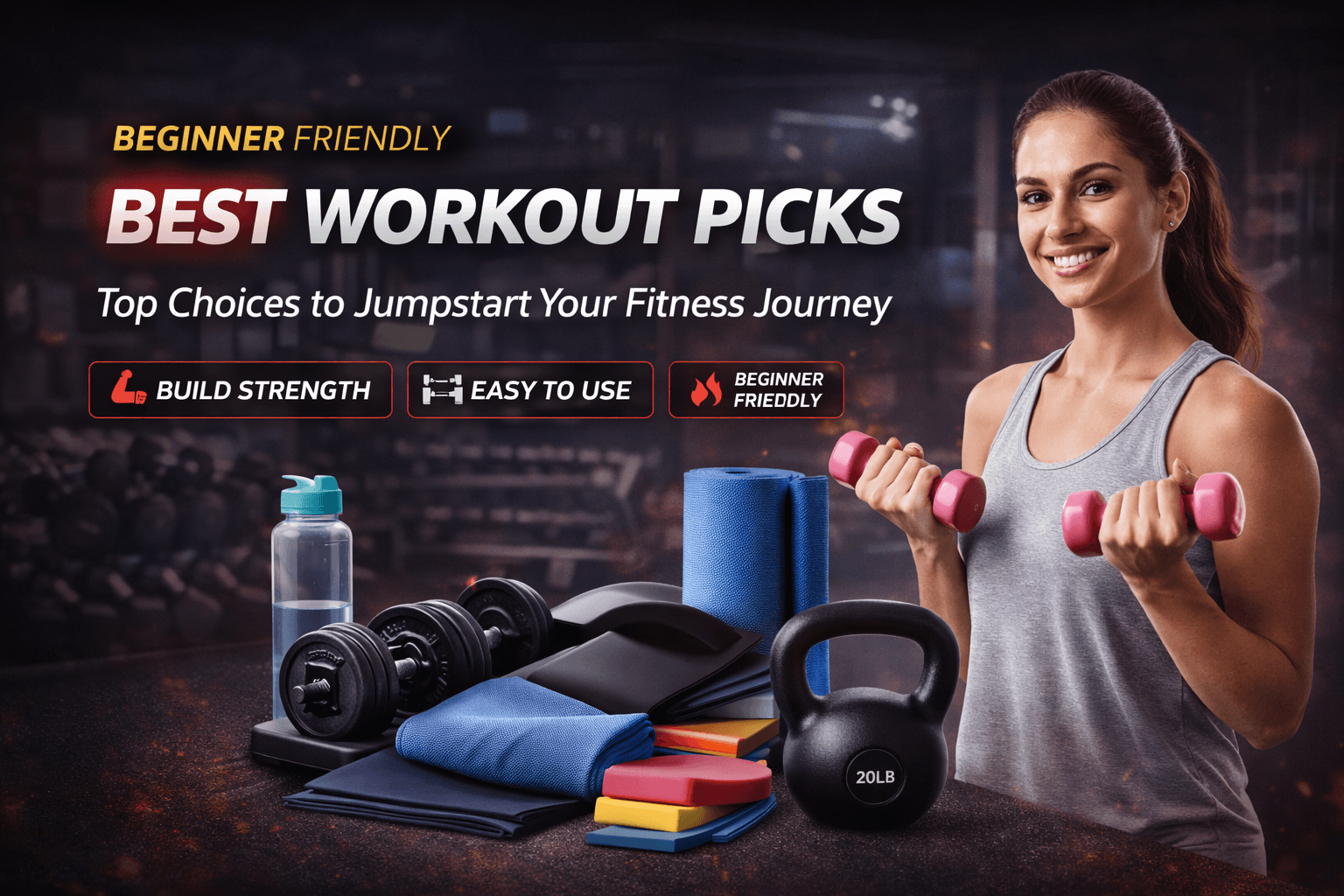
You do not need a fully equipped gym to run this beginner workout routine effectively. Here is the minimum viable equipment list with affiliate links:
Essential:
- Adjustable dumbbells (5–25kg range) 👉View on Mr Price Sport→ or View on Shein → or View on Amazon →
- Resistance band set (3 bands) 👉View on Mr Price Sport→ or View on Shein →
- Doorframe pull-up bar 👉 View on Shein→
- Ab roller 👉View on Mr Price Sport→ or View on Shein →
- Weighted jump rope 👉View on Mr Price Sport→ or View on Shein →
Recommended additions:
- Flat weight bench 👉 View on Amazon → Or View on AliExpress→
- Gym rubber flooring tiles 👉View on Mr Price Sport→ or View on Amazon → or View on Shein→
- Gym mat for floor work 👉View on Mr Price Sport→ or View on Shein→
Total estimated cost: R2,500 | $150 – R4,500 | $269.99 for the essential list depending on dumbbell weight range chosen.
Frequently Asked Questions
How long before I see results from my beginner workout routine? Strength improvements begin within the first two weeks as your nervous system adapts. Visible muscle and body composition changes typically appear between weeks 6 and 10 depending on nutrition consistency and starting point.
Can I do this workout routine at home without a gym? Yes — this entire programme is designed for home gym training. Adjustable dumbbells, resistance bands, and a pull-up bar cover every exercise in the programme.
How many rest days do I need? At minimum one rest day between every training session. The 3 day per week schedule — Monday, Wednesday, Friday — provides this automatically. On rest days light walking, stretching, or a skipping rope session is beneficial and does not impair recovery.
What should I eat before training? A meal containing complex carbohydrates and protein 1–2 hours before training is optimal. Oats with protein powder, chicken and rice, or eggs on toast are all effective pre-training meals for beginners.
Can women follow this beginner workout routine? Absolutely — this programme is equally effective for men and women. Women will not build bulky muscle from this routine. The hormonal profile required for significant muscle mass does not exist in most women without specific programming and nutritional strategies far beyond what this programme involves.
What to Do After 12 Weeks
After completing 12 weeks of this beginner workout routine you are no longer a beginner. Your next step is an intermediate programme that introduces more volume, exercise variety, and training splits.
Visit our Workout Routines page for intermediate and advanced programmes to follow after completing this foundation phase.
For a complete guide to building your home gym setup to support this programme visit our Budget Home Gym Guide.
To optimise your supplement stack beyond the basics covered here visit our Gym Supplements page for a complete breakdown of every supplement worth taking at every training stage.
Use our free BMI Calculator to track your body composition progress throughout the 12 weeks — recalculate every 4 weeks to monitor changes.