Introduction
Every training principle in fitness — periodisation, supersets, drop sets, tempo training, deload weeks, split programmes — exists in service of one fundamental concept. Remove that concept and every other principle becomes meaningless. Apply it consistently and almost any reasonable training programme produces results.
That concept is progressive overload.
Progressive overload is the single most important principle in resistance training. It is the reason some people train for years and build impressive physiques while others train for the same period and look virtually identical to when they started. It is the difference between training and exercising — and understanding it completely changes how you approach every single session in your home gym.
This guide explains progressive overload from the ground up — what it is, why it works, how to apply it across every exercise and fitness level, how to track it, and what to do when progress stalls.
What Is Progressive Overload
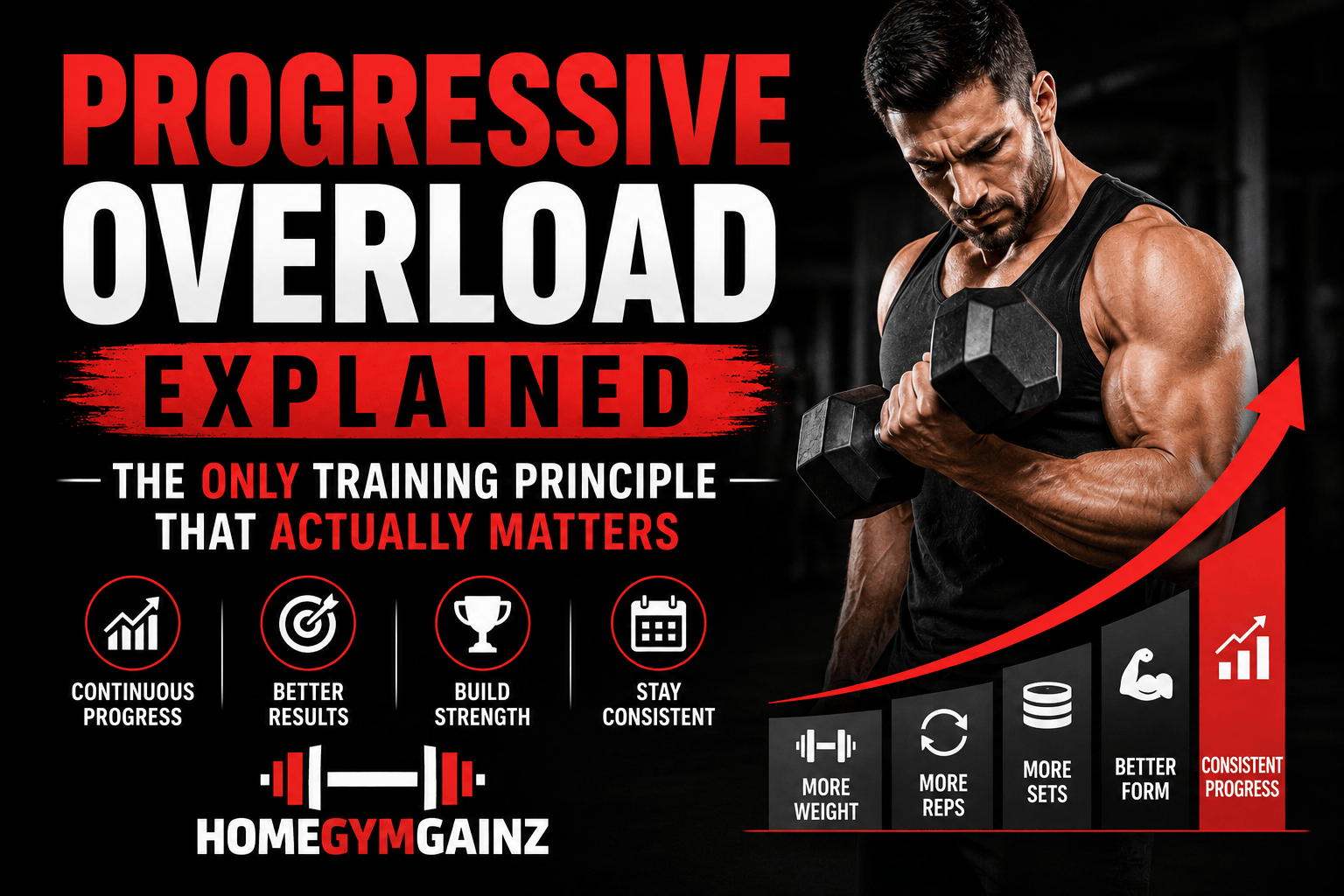
Progressive overload is the systematic increase of training stimulus over time to continue forcing the body to adapt beyond its current capacity.
In simpler terms — your body only changes when it is forced to do something it could not previously do. The moment your training becomes something your body can handle comfortably it stops producing adaptation. The moment you demand more than your body is currently capable of it responds by getting stronger, building more muscle, and becoming more capable.
Progressive overload is the mechanism by which you consistently deliver that demand.
The concept was formalised by Dr Thomas DeLorme in the 1940s during his work rehabilitating injured World War II soldiers. DeLorme observed that muscles would only grow and strengthen when subjected to loads greater than they were accustomed to — and that gradually increasing those loads over time produced continuous improvement. His findings became the foundation of modern resistance training science.
Why Progressive Overload Is the Only Principle That Actually Matters
This is a strong claim — but it is supported by both the research and practical experience of every serious athlete and coach in the history of strength training.
Consider what happens without progressive overload:
You perform the same workout with the same weights for the same reps week after week. In the first few weeks your body adapts — you get stronger, you build some muscle, your cardiovascular fitness improves. Then adaptation stops. Your body has reached a new equilibrium — it can handle your training comfortably and has no biological reason to continue changing.
This is why most people who train regularly for years look and perform very similarly to how they did after their first 3 months of training. They are exercising — expending energy, maintaining what they have built — but they are not training in the true sense. Without progressive overload there is no stimulus for continued adaptation.
Now consider what happens with consistent progressive overload:
Every session or every few sessions you demand slightly more from your body than it could previously deliver. Your body responds to this consistent demand by continuously adapting — building more muscle to handle heavier loads, developing stronger connective tissue, improving neuromuscular efficiency, and increasing cardiovascular capacity. This continuous adaptation is what separates people who transform their bodies from people who maintain them.
The Science Behind Progressive Overload
Progressive overload works through a biological process called the stress-recovery-adaptation cycle:
Stress — You apply a training stimulus that exceeds your body’s current capacity. This creates microscopic damage to muscle fibres and metabolic stress in the trained tissues.
Recovery — During the 24 to 72 hours following training your body repairs the damaged tissue — rebuilding it slightly stronger and more capable than before through a process called muscle protein synthesis.
Adaptation — After sufficient recovery your body has adapted to the previous training stimulus. It is now marginally stronger, slightly more muscular, and better equipped to handle that specific demand.
New stress — Progressive overload requires you to increase the demand at this point — before adaptation becomes comfortable equilibrium. A slightly heavier weight, an additional rep, a shorter rest period, or a more challenging variation ensures the next training stimulus exceeds the body’s new adapted capacity and restarts the cycle.
This cycle — applied consistently over months and years — is the mechanism by which every meaningful physical transformation occurs.
The Seven Methods of Progressive Overload
Most people think progressive overload means adding weight to the bar — and while that is the most common application it is one of seven distinct methods available. Understanding all seven gives you options when the most obvious method of adding weight is not available or appropriate.
Method 1 — Increase Load
The most straightforward and most effective method of progressive overload — add more weight to the exercise.
How to apply: When you can complete all programmed sets and reps with good form and 2 or more reps remaining in reserve — add weight at your next session.
Practical increments:
- Barbell exercises — add 2.5kg to the bar per session
- Dumbbell exercises — add 2kg per dumbbell per session
- When 2kg jumps become too large — add 1kg per dumbbell
- When 1kg jumps become too large — switch to a different overload method
Why it is the most effective method: Load progression directly increases the mechanical tension placed on muscle fibres — the primary driver of muscle hypertrophy and strength development. All other overload methods are partially substituting for load increases rather than directly replicating them.
👉 Shop Adjustable Dumbbells at Mr Price Sport → 👉 View Adjustable Dumbbell Set on Shein → 👉 View Adjustable Dumbbells on Amazon →
Method 2 — Increase Reps
Performing more repetitions at the same load increases the total training volume — a key driver of muscle hypertrophy.
How to apply: If you performed 3 sets of 10 goblet squats at 16kg last session — perform 3 sets of 11 or 12 at the same weight this session. Once you reach the top of your target rep range with that weight — typically 15 reps for hypertrophy work — increase the load and return to the bottom of the rep range.
Example progression:
- Week 1 — 3 x 10 at 16kg
- Week 2 — 3 x 12 at 16kg
- Week 3 — 3 x 15 at 16kg
- Week 4 — 3 x 10 at 18kg (load increased, reps reset)
This rep-load progression model is one of the most practical approaches to progressive overload for home gym training where small weight increments are not always available.
Method 3 — Increase Sets
Adding an additional set of an exercise increases total training volume without requiring heavier weights or more reps per set.
How to apply: Progress from 3 sets to 4 sets of a given exercise. Once you comfortably complete 4 sets increase the load and return to 3 sets.
When to use this method: Set progression is most useful when you have reached the top of your rep range but do not yet have a heavier weight available — adding a set maintains progressive stimulus until the next weight increment becomes appropriate.
Method 4 — Decrease Rest Periods
Performing the same work in less total time increases the metabolic demand and cardiovascular challenge of a session — representing a form of progressive overload particularly relevant for conditioning and fat loss training.
How to apply: If you currently rest 90 seconds between sets of goblet squats reduce rest to 75 seconds. Then 60 seconds. Then 45 seconds. Once you reach your minimum acceptable rest period for that exercise and load level increase the load and return to longer rest periods.
Important caveat: Reduced rest periods are appropriate for hypertrophy and conditioning work — not for maximum strength development. Heavy compound movements like squats and deadlifts require 2 to 3 minutes of rest to allow full ATP and phosphocreatine restoration. Reducing rest on these movements compromises the loads you can handle and limits strength development.
Method 5 — Increase Range of Motion
Performing an exercise through a greater range of motion increases the mechanical work performed and the stretch placed on the muscle — both of which contribute to muscle development.
How to apply:
- Progress from knee push-ups to full push-ups — greater range of motion
- Progress from parallel squats to full depth squats — greater range of motion
- Progress from floor flies to flies with elevated shoulders — greater chest stretch
- Add push-up handles to standard push-ups — allows hands to go below floor level increasing chest stretch
Why range of motion matters: Research consistently shows that exercises performed through a full range of motion produce greater muscle hypertrophy than partial range equivalents at the same load. Progressing from a partial to a full range of motion on any exercise is a meaningful progressive overload stimulus.
👉 View Push-Up Handles on Shein→
Method 6 — Increase Training Frequency
Training a muscle group more frequently — while maintaining adequate recovery — increases the number of muscle protein synthesis peaks per week and accelerates development.
How to apply: Progress from training a muscle group once per week to twice per week. Then from twice to three times per week for advanced athletes with sufficient recovery capacity.
The recovery requirement: Frequency progression only produces results if recovery is adequate between sessions. Training a muscle group three times per week while sleeping 5 hours per night and eating insufficient protein will produce worse results than training it twice per week with proper sleep and nutrition.
Method 7 — Improve Exercise Difficulty
Progress to a more technically demanding variation of the same movement pattern — increasing the strength, stability, and coordination required.
Practical examples:
- Bodyweight squat → goblet squat → barbell back squat
- Standard push-up → wide push-up → push-up with feet elevated → archer push-up
- Glute bridge → single leg glute bridge → barbell hip thrust
- Resistance band row → dumbbell row → barbell row
- Assisted pull-up → full pull-up → weighted pull-up
Exercise difficulty progression is particularly valuable for bodyweight training where load increases are not possible — it provides a clear progression pathway that produces continued adaptation without requiring additional equipment.
How to Track Progressive Overload — The Non-Negotiable Habit
Progressive overload without tracking is guesswork. You cannot know whether you are progressing if you do not record where you started and where you currently are.
What to track for every session:
- Date
- Exercise name
- Weight used
- Sets completed
- Reps completed per set
- Notes on form, difficulty, or how you felt
The simplest tracking system:
A plain notebook dedicated exclusively to your training log. Write the date at the top of each page, list your exercises, and record your numbers. This takes 2 minutes per session and provides the complete historical record you need to manage progressive overload systematically.
Example training log entry:
Monday 25 April 2026 Goblet Squat — 20kg — 4 x 12, 12, 11, 10 Romanian Deadlift — 18kg — 4 x 12, 12, 12, 11 Floor Press — 22kg — 3 x 10, 10, 9 Band Row — Heavy band — 3 x 15, 15, 14 Ab Roller — 3 x 10, 10, 8
This record tells you exactly what to beat next session. If you completed 4 sets of 12 goblet squats at 20kg this session — next session you target 4 x 13 or increase to 22kg for 4 x 10.
Digital alternatives:
- Notes app on your phone — simplest digital option
- Google Sheets — allows easy tracking and graph creation
- Strong app — free workout tracking app with progressive overload logging built in
Progressive Overload for Different Training Goals
Progressive overload looks different depending on your primary training goal. Here is how to apply it specifically for each objective:
Progressive Overload for Muscle Building (Hypertrophy)
Primary overload method: Volume progression — increasing total sets multiplied by reps multiplied by load over time.
Rep range: 6 to 20 reps per set — the full hypertrophy spectrum. Research shows muscle growth occurs across this entire rep range when sets are taken close to failure.
Practical application: Start at the lower end of your rep range with a challenging weight. Add reps each session until you reach the top of the range. Then increase load and return to the lower end. Repeat indefinitely.
Progressive overload target: Increase total weekly training volume — measured in sets multiplied by reps multiplied by load — by 5 to 10% every 2 to 4 weeks.
Progressive Overload for Strength
Primary overload method: Load progression — consistently increasing the weight on primary compound movements.
Rep range: 1 to 6 reps per set at very high intensity — 85 to 95% of maximum effort.
Practical application: Add the smallest available weight increment to your primary lifts each session. For most home gym athletes this means 2.5kg per barbell session or 2kg per dumbbell per session. This linear progression model works for beginners and intermediates and produces the fastest strength gains available.
Progressive overload target: Add weight to your primary lifts every session for as long as linear progression allows — typically 3 to 6 months for beginners before switching to wave loading or other intermediate strength protocols.
👉 Shop Xpeed Olympic Barbells at Mr Price Sport → 👉 Shop Barbells at Mr Price Sport →
👉 Shop Weight Plates at Mr Price Sport → 👉 View Olympic Barbell on Amazon →
Progressive Overload for Fat Loss
Primary overload method: Volume and density progression — more total work in the same or less time.
Application: Maintain or increase training loads during a fat loss phase to preserve lean muscle mass. As body weight decreases your relative strength — load as a percentage of body weight — actually increases even when absolute loads remain the same. This relative progression is a legitimate form of progressive overload.
Progressive overload target: Maintain current training loads throughout a fat loss phase. Any absolute load increase represents superior performance given the calorie deficit context.
Progressive Overload for Beginners
Beginners experience the fastest progressive overload of any training stage — a phenomenon called newbie gains. The nervous system, which has never been subjected to resistance training, adapts so rapidly in the first 3 to 6 months that beginners can add weight every single session on most exercises.
The beginner progressive overload protocol:
- Add weight to every exercise every session for as long as possible
- When you cannot add weight to the primary exercise on a given day add reps instead
- When you cannot add reps add a set
- Linear progression — adding load every session — works for beginners longer than any other group
The most important advice for beginners:
Do not change your programme while it is working. The most common beginner mistake is abandoning a simple effective progressive overload programme for a more complicated one before the simple programme has been given enough time. If you are adding weight or reps every session your programme is working — keep going.
When Progressive Overload Stalls — What to Do
Every athlete eventually reaches a point where they cannot add weight, reps, or volume to a given exercise despite consistent effort. This is called a plateau and it is a normal part of long-term training development.
The most common causes of plateaus:
Insufficient sleep — The recovery process that produces adaptation occurs primarily during sleep. Consistently sleeping less than 7 hours per night impairs muscle protein synthesis and prevents the adaptation that progressive overload requires. No training strategy overcomes chronic sleep deprivation.
Insufficient protein — If you are not consuming 1.6 to 2g of protein per kilogram of body weight daily your body lacks the raw materials required to rebuild trained muscle tissue stronger than before. Progressive overload stimulus without adequate protein is like trying to build a house without cement.
Insufficient calories — Building muscle requires a calorie surplus. In a significant calorie deficit your body prioritises energy availability over muscle building — making progressive overload significantly harder to achieve.
Too much training without adequate recovery — More training is not always better. If you are training a muscle group too frequently without sufficient recovery time between sessions you are accumulating fatigue faster than adaptation is occurring. Reduce frequency or add a deload week.
Programme monotony — The same exercises performed the same way for extended periods eventually produce diminishing returns as the body adapts completely to that specific movement pattern. Introducing exercise variation — not programme hopping but strategic variation of secondary exercises while maintaining primary compound movements — provides new stimuli.
Solutions for plateaus:
Deload week — Reduce training volume and intensity by 40 to 50% for one week. This allows accumulated fatigue to dissipate and often results in significant performance improvements in the following week.
Switch overload method — If load progression has stalled switch to rep progression, set progression, or rest period reduction for 4 to 6 weeks before returning to load progression.
Address nutrition — Track your food intake for one week. The most common plateau cause is insufficient protein or calories — both of which are invisible without tracking.
Address sleep — Prioritise 7 to 9 hours of quality sleep. This single change resolves more training plateaus than any training modification.
Progressive Overload and Supplements — What Actually Helps
Certain supplements directly support the progressive overload process by improving training performance and recovery:
Creatine Monohydrate — The Most Impactful
Creatine directly enhances the progressive overload process by increasing phosphocreatine availability in muscle cells — allowing more reps at heavier weights before fatigue sets in. Research consistently shows creatine supplementation increases strength on primary compound movements by 5 to 15% over 4 to 8 weeks — accelerating the load progression that is the primary driver of progressive overload.
Take 3 to 5g daily. Consistent daily use maintains full muscle creatine saturation.
🇿🇦 SA Local: 👉 View Creatine at Faithful to Nature →
🌍 International: 👉 View Creatine at Amazon Food→
Whey Protein — Essential for Recovery
Progressive overload produces the stimulus for adaptation. Protein provides the raw materials for that adaptation to occur. Without adequate protein progressive overload produces training stress without the recovery and rebuilding that turns that stress into muscle and strength.
🇿🇦 SA Local: 👉 View Protein at Faithful to Nature →
🌍 International: 👉 View Whey Protein at HerbsPro →
Magnesium Glycinate — Sleep and Recovery
Sleep quality is the most underrated variable in progressive overload. The majority of muscle protein synthesis — the process by which training stimulus is converted into actual muscle growth — occurs during deep sleep. Magnesium deficiency directly impairs sleep depth. Take 200 to 400mg before bed.
🇿🇦 SA Local: 👉 View Magnesium at Faithful to Nature →
🌍 International: 👉 View Magnesium at HerbsPro →
Progressive Overload Mistakes — What to Avoid
Increasing load before technique is solid Adding weight to a movement with poor technique teaches your body to move incorrectly under increasing loads — building strength in a pattern that causes injury. Always master technique at lighter loads before progressing to heavier ones.
Changing programmes too frequently A new programme every 4 to 6 weeks prevents progressive overload from compounding. Each time you change your programme your body spends the first 2 to 3 weeks adapting to the new movement patterns — time that could have been spent adding load to a familiar programme. Stay on a programme for at least 8 to 12 weeks before changing.
Ignoring the mind-muscle connection Moving weight from point A to point B without focusing on the working muscle produces less muscle activation than the same movement performed with deliberate attention to the contracting muscle. Progressive overload through increased load is less effective when muscle activation is poor — focus on feeling the target muscle working throughout each rep.
Training to failure every session Training to absolute failure — the point at which you genuinely cannot complete another rep — is not required for progressive overload and actually impairs it when applied too frequently. Training to 1 to 2 reps before failure — leaving reps in reserve — produces comparable muscle development with significantly better recovery and more consistent progressive overload over time.
Comparing your progression to others Progressive overload is personal. Your rate of progression depends on your training age, genetics, sleep quality, nutrition, stress levels, and dozens of other individual factors. The only relevant comparison is your current performance versus your previous performance. Your goal is to be better than you were last week — not better than someone else.
Putting It All Together — Your Progressive Overload Action Plan
Step 1 — Start a training log today Before your next session create your training log — notebook, phone notes app, or Google Sheets. Record every exercise, weight, sets, and reps from this session forward.
Step 2 — Identify your current baseline Your first session with a training log establishes your baseline. Every subsequent session is measured against this baseline.
Step 3 — Apply the simplest overload method first For most exercises start with load progression — add 2kg to dumbbells or 2.5kg to barbells when you complete all programmed reps. Only switch to alternative overload methods when load progression stalls.
Step 4 — Address the recovery variables Ensure you are sleeping 7 to 9 hours per night, consuming 1.6 to 2g of protein per kilogram of body weight daily, and eating at least at maintenance calories. Progressive overload without these foundations produces minimal results.
Step 5 — Be patient with the process Progressive overload is a long-term strategy. The results are not visible week to week — they are visible month to month and year to year. The athletes with the most impressive physiques are not those who trained hardest for 3 months — they are those who applied progressive overload consistently for 3 years.
Frequently Asked Questions
How much should I increase weight each session? For beginners on compound movements — 2.5kg per barbell session or 2kg per dumbbell per session. For intermediate athletes — 2.5kg per week on compound movements is excellent progress. For advanced athletes — 2.5kg per month on primary lifts represents solid progression.
Can I apply progressive overload with bodyweight exercises? Yes — through rep progression, set progression, rest period reduction, range of motion progression, and exercise difficulty progression as covered in this guide. Bodyweight training has a lower ceiling than weighted training but progression is entirely possible within that ceiling.
How long should I stay on the same programme? At minimum 8 weeks. Ideally 12 to 16 weeks for beginners. Changing programmes before progressive overload has had time to produce results is one of the most common training mistakes.
Should I deload regularly? Planned deload weeks every 4 to 8 weeks are beneficial for intermediate and advanced athletes accumulating significant training fatigue. Beginners rarely need planned deloads — their lower training volumes do not accumulate fatigue at the rate that requires systematic deloading.
What if I miss a session? Missing one session does not meaningfully impact progressive overload. Resume your normal programme at your last recorded weights. Missing multiple sessions — more than 1 to 2 weeks — may require a brief period at slightly reduced loads before returning to previous levels as neuromuscular efficiency temporarily declines during extended training breaks.
Your Next Steps
Progressive overload is not a training technique — it is the foundational principle that makes every training technique work. Apply it to every session, track it religiously, support it with adequate nutrition and sleep, and it will produce results in any reasonable training programme.
For workout programmes built around progressive overload principles visit our Best Workout Routine for Beginners and our Beginner Workout Plan for Women.
For the complete legs workout programme applying progressive overload across three levels visit our Legs Workout at Home guide.
For chest training with progressive overload applied across beginner to advanced levels visit our Chest Workouts With Dumbbells guide.
For the equipment you need to apply progressive overload in your home gym visit our Dumbbells and Weights page and our Budget Home Gym Guide.
For supplement support that directly enhances progressive overload performance visit our Gym Supplements page and our Creatine Timing guide.
Use our free BMI Calculator to establish your starting body composition and track how progressive overload changes your body over time.