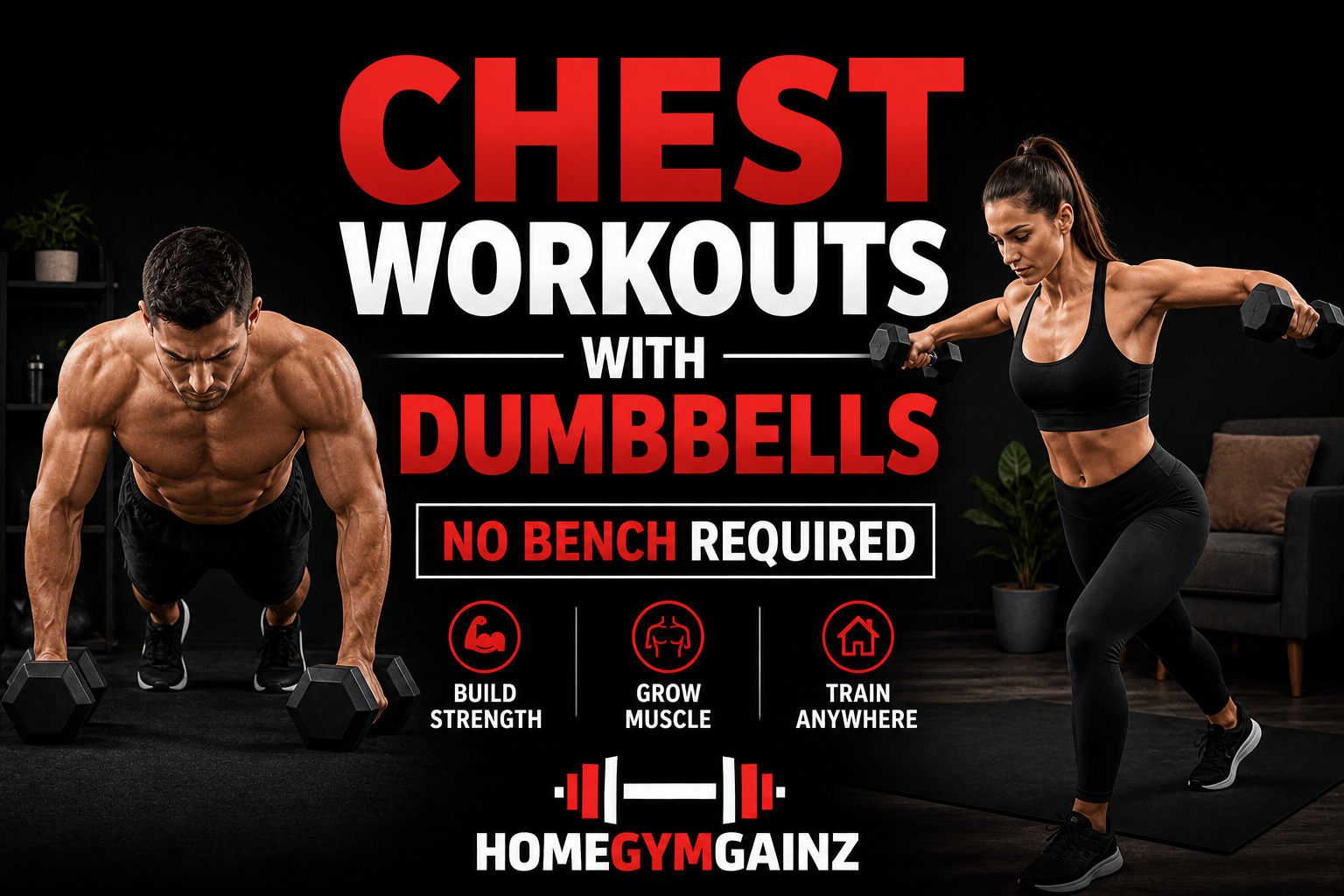
The bench press is not the only path to a developed chest. In fact for most home gym training environments — where a quality bench is either not yet purchased or simply not available — dumbbell chest exercises performed on the floor produce comparable muscle development to bench-based pressing when programmed correctly.
This guide covers the most effective chest workouts with dumbbells available for home gym training — from complete beginners with no equipment to intermediate and advanced lifters with a full dumbbell range. Every exercise includes detailed technique guidance, progressive overload strategies, and affiliate links for the best dumbbells and accessories available locally in South Africa.
No bench required. No gym membership required. Just proven chest workout programming you can execute in your home gym today.
Why Chest Workouts With Dumbbells Work
Before getting into the exercises it is worth understanding why dumbbells are not a compromise for chest training — they are in many ways superior to barbell pressing for chest development specifically.
Greater range of motion — Dumbbells allow each arm to move independently through a fuller range of motion than a barbell. At the bottom of a dumbbell press your hands can travel wider and lower than a barbell allows — producing a greater chest stretch and more complete muscle fibre recruitment throughout the movement.
Better muscle activation — Research using electromyography consistently shows that dumbbell pressing activates the pectoralis major more effectively than barbell pressing at matched loads. The requirement for each arm to stabilise independently increases the demand on the chest musculature.
Reduced shoulder stress — The fixed hand position of a barbell forces your wrists, elbows, and shoulders into a predetermined path that does not accommodate individual anatomy. Dumbbells allow your hands to rotate naturally throughout the pressing movement — reducing shoulder joint stress and making heavy pressing more sustainable long-term.
Unilateral balance — Barbell pressing allows the stronger side to compensate for the weaker side. Dumbbell pressing forces each side to work independently — identifying and correcting left-right strength imbalances before they become structural problems.
No spotter required — Heavy barbell bench pressing without a spotter is genuinely dangerous. Dumbbell pressing — particularly floor pressing — can be performed safely alone at maximum effort. You can simply lower the dumbbells to the floor if you reach failure.
Understanding Chest Anatomy — Why It Matters for Your Workout
A complete chest workout with dumbbells must target all three regions of the pectoralis major:
Upper chest (clavicular head) — The upper portion of the chest running from the clavicle toward the shoulder. Developed by incline pressing movements. The most commonly underdeveloped region — giving the chest a “drooping” appearance when neglected.
Middle chest (sternal head) — The largest portion of the pectoralis major. Developed by flat pressing movements. The primary mover in standard push-ups and floor press variations.
Lower chest — The lower portion running toward the abdomen. Developed by decline pressing movements and dips. Contributes to the defined lower chest separation that creates the athletic chest appearance.
A chest workout with dumbbells that only includes flat pressing develops the middle chest while leaving the upper and lower regions underdeveloped — creating an imbalanced appearance and incomplete strength development. The programme below addresses all three regions.
Equipment You Need for Dumbbell Chest Workouts
Essential:
Adjustable dumbbells are the most important purchase for any home gym chest workout. A quality adjustable set covering 5kg to 25kg per hand covers every chest exercise in this guide from beginner to intermediate level.
🇿🇦 SA Local — Mr Price Sport: 👉 Shop Dumbbells at Mr Price Sport →
🌍 International — Shein: 👉 View Adjustable Dumbbell Set on Shein →
🌍 International — Amazon: 👉 View Adjustable Dumbbells on Amazon →
Highly Recommended:
Resistance bands — Unlock banded chest fly variations and add accommodating resistance to push-ups. Essential for complete chest development without a cable machine.
🇿🇦 SA Local — Mr Price Sport: 👉 Shop Resistance Bands at Mr Price Sport →
🌍 International — Shein: 👉 View Resistance Band Set on Shein →
Optional but Valuable:
Push-up handles — Elevate your hands during push-ups to increase range of motion and chest stretch beyond what flat floor push-ups allow. One of the highest value-to-cost accessories available for chest training.
Gym mat — Protects your floor during floor press variations and provides comfort during push-up sets.
🇿🇦 SA Local — Mr Price Sport: 👉 View Gym Mat on Mr Price Sport→
🌍 International — Shein: 👉 View Gym Mat on Shein→ 👉 View Push-Up Handles on Shein→
LEVEL 1 — Beginner Chest Workout With Dumbbells — No Equipment Needed
This beginner chest workout with dumbbells starts with bodyweight movements before progressing to loaded exercises. Complete this programme 2 days per week with at least 2 days rest between sessions.
Exercise 1 — Standard Push-Up
Sets: 3 | Reps: As many as possible | Rest: 90 seconds
The push-up is the foundation of every chest workout with dumbbells programme. It trains the pectoralis major, anterior deltoid, and triceps simultaneously through a natural pressing pattern — and requires zero equipment making it the most accessible chest exercise available.
How to perform: Place your hands slightly wider than shoulder width on the floor — fingertips pointing forward or very slightly outward. Body forms a straight line from head to heels — brace your core hard. Lower your chest to the floor with elbows at 45 degrees from your body — not flared out to 90 degrees which stresses the shoulder joint. Press back to the starting position with control.
Knee modification: Same movement with knees on the floor. This reduces the load by approximately 50% making it appropriate for complete beginners who cannot yet perform full push-ups.
Progression target: Work toward 3 sets of 20 consecutive full push-ups before progressing to weighted chest exercises.
Common mistake: Letting your hips sag toward the floor or rise above the line of your body. Both indicate core weakness — brace harder and reduce reps if necessary to maintain form.
Exercise 2 — Wide Push-Up
Sets: 3 | Reps: 12 to 15 | Rest: 75 seconds
The wide push-up shifts the emphasis from the triceps toward the chest by increasing the horizontal adduction demand — the movement of bringing your arms across your body that is the primary function of the pectoralis major.
How to perform: Same as a standard push-up but with hands placed significantly wider than shoulder width — approximately 1.5 times shoulder width. The wider hand position reduces tricep contribution and increases chest activation throughout the pressing movement.
Exercise 3 — Incline Push-Up
Sets: 3 | Reps: 15 | Rest: 75 seconds
The incline push-up — performed with feet elevated — shifts the pressing angle to target the lower chest. This is the bodyweight equivalent of a decline bench press and one of the most overlooked chest exercises for home training.
How to perform: Place your feet on a chair, sofa, or step — hands on the floor at shoulder width. Your body forms a straight line from head to heels at a downward angle. Perform the push-up movement — lowering your chest toward the floor and pressing back up. The steeper the foot elevation the greater the lower chest emphasis.
Progression: Increase foot elevation height as the exercise becomes easier — a higher angle increases the load on the lower chest progressively.
Exercise 4 — Decline Push-Up
Sets: 3 | Reps: 12 | Rest: 75 seconds
The decline push-up — performed with hands elevated — shifts the pressing angle to target the upper chest. This is the bodyweight equivalent of an incline bench press.
How to perform: Place your hands on a chair or step — feet on the floor. Your body angles downward from hands to feet. Perform the push-up movement. The higher the hand elevation the greater the upper chest emphasis.
Exercise 5 — Push-Up Hold — Isometric Chest Squeeze
Sets: 3 | Duration: 20 to 30 seconds | Rest: 60 seconds
How to perform: Lower into the bottom position of a push-up — chest near the floor. Hold this position for the target duration while maintaining full body tension. This isometric hold develops the deep chest strength that translates to better pressing performance.
Beginner Chest Workout Summary
| Exercise | Sets | Reps | Rest |
|---|---|---|---|
| Standard Push-Up | 3 | Max reps | 90 sec |
| Wide Push-Up | 3 | 12–15 | 75 sec |
| Incline Push-Up | 3 | 15 | 75 sec |
| Decline Push-Up | 3 | 12 | 75 sec |
| Push-Up Hold | 3 | 20–30 sec | 60 sec |
LEVEL 2 — Intermediate Chest Workout With Dumbbells — No Bench
This intermediate chest workout with dumbbells uses a full dumbbell range to produce significant chest development across all three regions. No bench required — every exercise is performed on the floor. Complete 2 days per week with at least 2 days rest between sessions.
Exercise 1 — Dumbbell Floor Press
Sets: 4 | Reps: 10 to 12 | Rest: 90 seconds
The dumbbell floor press is the most important exercise in any chest workout with dumbbells programme for home gym training without a bench. It trains the pectoralis major through a full pressing pattern — the floor simply acts as a natural range of motion limiter that actually reduces shoulder joint stress compared to full bench press depth.
Research shows the dumbbell floor press produces comparable pectoralis major activation to the full bench press at matched loads — making the “you need a bench for chest training” claim significantly overstated.
How to perform: Lie on your back on the floor with knees bent and feet flat. Hold dumbbells at chest height with elbows at 45 degrees from your body — upper arms resting on the floor. Press the dumbbells directly up until your arms are fully extended. Lower with control until your upper arms make contact with the floor — pause briefly — then press again. The pause eliminates the elastic rebound that allows lifters to use more weight than they can control.
Starting weight: Men — 14 to 20kg per dumbbell. Women — 8 to 14kg per dumbbell.
Progressive overload: Add 2kg per dumbbell when you can complete all reps with full control and a brief pause at the bottom.
👉 Shop Dumbbells at Mr Price Sport → 👉 View Adjustable Dumbbells on Shein →
Exercise 2 — Dumbbell Floor Fly
Sets: 3 | Reps: 12 to 15 | Rest: 75 seconds
The dumbbell floor fly is the most effective isolation exercise for the chest available in a no-bench home gym setup. While the pressing movements train the chest as a prime mover alongside the triceps and deltoids the fly isolates the pectoralis major specifically — developing the stretch and contraction that builds chest width.
How to perform: Lie on your back on the floor with knees bent. Hold dumbbells directly above your chest with palms facing each other and a slight bend in your elbows — maintain this elbow angle throughout the movement. Lower the dumbbells out to your sides in a wide arc until your upper arms contact the floor. Drive the dumbbells back up through the same arc — squeezing your chest hard at the top as if hugging a large tree trunk.
The key feeling: You should feel a significant stretch across the chest at the bottom of each rep and a strong contraction at the top. If you feel the movement in your shoulders your elbows are too straight — maintain the slight bend throughout.
Starting weight: Men — 8 to 14kg per dumbbell. Women — 4 to 8kg per dumbbell. The fly requires significantly lighter weight than the press — ego loading on this exercise causes shoulder injuries.
Exercise 3 — Incline Dumbbell Floor Press
Sets: 3 | Reps: 12 | Rest: 90 seconds
Targeting the upper chest without an adjustable bench requires creative use of your environment. The incline dumbbell floor press achieves this by elevating your upper back on a folded blanket, yoga mat, or firm cushion — changing the pressing angle to emphasise the clavicular head of the pectoralis major.
How to perform: Place a folded blanket or firm cushion under your upper back — elevating your torso to approximately a 30 degree angle. Perform the floor press from this elevated position. The inclined angle shifts the pressing emphasis toward the upper chest.
Alternative: If you have a sofa or low coffee table you can press from this angle using the elevated surface as your back support.
Starting weight: Men — 12 to 16kg per dumbbell. Women — 6 to 10kg per dumbbell.
Exercise 4 — Push-Up With Dumbbell Row — Superset
Sets: 3 | Reps: 10 push-ups + 10 rows each arm | Rest: 90 seconds
This superset combines a chest pressing movement with a back pulling movement — maintaining the push-pull balance that prevents the rounded-shoulder posture that develops when chest training is not counterbalanced by adequate pulling work.
How to perform: Place two dumbbells on the floor shoulder-width apart. Grip the dumbbell handles and perform a push-up from this position — the raised hand position increases the range of motion and chest stretch beyond a standard floor push-up. At the top of the push-up perform a dumbbell row with one arm — pulling the dumbbell toward your hip while your opposite hand supports your body weight. Alternate arms each rep.
Starting weight: Use a weight that challenges you for 10 rows on each side.
👉 Shop Dumbbells at Mr Price Sport →
Exercise 5 — Resistance Band Chest Fly
Sets: 3 | Reps: 15 | Rest: 60 seconds
The resistance band chest fly replicates the cable fly — one of the most effective chest isolation exercises available in commercial gyms — using only a resistance band. This exercise is particularly valuable for developing the inner chest — the deep separation between the two pectoral muscles that creates the defined chest appearance.
How to perform: Anchor a resistance band at chest height — loop it around a door frame, wrap it around a sturdy post, or have someone hold it. Stand facing away from the anchor point holding one end of the band in each hand with arms extended to your sides. Step forward until there is significant tension in the band. Bring your hands together in front of your chest in a wide hugging arc — squeezing your chest hard at the point where your hands meet. Control the return slowly.
Alternative — Lying Band Fly: Lie on the floor with a resistance band anchored behind your head. Perform the fly movement horizontally — this replicates the cable fly more closely than the standing variation.
👉 Shop Resistance Bands at Mr Price Sport → 👉 View Resistance Band Set on Shein →
Exercise 6 — Diamond Push-Up
Sets: 3 | Reps: 10 to 15 | Rest: 60 seconds
The diamond push-up places your hands in a close triangular formation directly under your chest — significantly increasing tricep activation while maintaining chest involvement. This variation develops the inner chest thickness and tricep strength that completes the aesthetic chest development.
How to perform: Place your hands on the floor in a diamond shape — thumbs and index fingers touching to form a triangle. Perform the push-up movement — lowering your chest toward your hands and pressing back up. The close hand position increases the difficulty significantly compared to standard push-ups.
Intermediate Chest Workout Summary — No Bench
| Exercise | Sets | Reps | Rest |
|---|---|---|---|
| Dumbbell Floor Press | 4 | 10–12 | 90 sec |
| Dumbbell Floor Fly | 3 | 12–15 | 75 sec |
| Incline Dumbbell Floor Press | 3 | 12 | 90 sec |
| Push-Up With Dumbbell Row | 3 | 10+10 | 90 sec |
| Resistance Band Chest Fly | 3 | 15 | 60 sec |
| Diamond Push-Up | 3 | 10–15 | 60 sec |
LEVEL 3 — Advanced Chest Workout With Dumbbells
This advanced chest workout with dumbbells incorporates heavier loading, more volume, and advanced techniques for experienced home gym athletes. A flat weight bench is recommended at this level but not essential — the floor press alternatives remain effective.
Exercise 1 — Heavy Dumbbell Floor Press — Pause Reps
Sets: 5 | Reps: 6 to 8 | Rest: 2 minutes
At the advanced level the dumbbell floor press becomes a genuine strength movement with heavy loading. Pause reps — a full 2-second pause at the bottom with upper arms on the floor — eliminate momentum and force pure muscle strength to move the load.
Starting weight: Men — 24 to 36kg per dumbbell. Women — 14 to 22kg per dumbbell.
Progressive overload: Add 2kg per dumbbell every 2 sessions when all sets are completed with the full 2-second pause.
👉 Shop Heavy Dumbbells at Mr Price Sport → 👉 View Heavy Dumbbell Set on Amazon →
Exercise 2 — Dumbbell Floor Press — 1.5 Rep Method
Sets: 3 | Reps: 8 | Rest: 90 seconds
The 1.5 rep method doubles the time under tension in the most challenging portion of the movement — producing superior chest muscle development compared to standard full reps at the same load.
How to perform: Press the dumbbells up from the floor (1 full rep). Lower to the floor (half rep). Press halfway up — to the point where your elbows are at 90 degrees (half rep). Lower to the floor again (half rep). Press all the way up (full rep). This entire sequence = 1.5 reps. Count reps by the number of full starting positions.
Exercise 3 — Dumbbell Floor Fly — Slow Eccentric
Sets: 4 | Reps: 12 | Rest: 75 seconds
The eccentric phase of the fly — the lowering portion — produces the greatest muscle damage and subsequent hypertrophic stimulus. Slowing the eccentric to 4 to 5 seconds significantly increases chest muscle development at the same weight.
How to perform: Same as the standard floor fly but lower the dumbbells over 4 to 5 seconds — counting deliberately. The return (concentric) is performed at normal speed.
Exercise 4 — Push-Up Handles — Deep Range Push-Up
Sets: 4 | Reps: Max | Rest: 90 seconds
Push-up handles elevate your hands above the floor — allowing your chest to descend below your hand level at the bottom of each rep. This increased range of motion produces a significantly greater chest stretch than standard floor push-ups — one of the most impactful single upgrades to bodyweight chest training available.
How to perform: Place push-up handles at shoulder width. Perform the push-up movement — at the bottom your chest descends below the level of your hands creating a deep stretch across the entire pectoral region. Press back to the starting position with control.
👉 View Push-Up Handles on Temu →
Exercise 5 — Resistance Band Chest Press — Constant Tension
Sets: 3 | Reps: 15 to 20 | Rest: 60 seconds
Resistance bands provide constant tension throughout the movement — unlike dumbbells which have a dead spot at the top of the press. This constant tension technique produces a different muscle stimulus that complements heavy dumbbell pressing effectively.
How to perform: Loop a resistance band behind your back at chest height — hold one end in each hand. Press your hands forward from chest level to full arm extension — the band increases resistance as you extend. Return slowly against the band tension.
👉 Shop Resistance Bands at Mr Price Sport →
Exercise 6 — Archer Push-Up
Sets: 3 | Reps: 8 each side | Rest: 90 seconds
The archer push-up is one of the most challenging bodyweight chest exercises — approaching the difficulty of a one-arm push-up while remaining more technically accessible. It develops unilateral chest strength and corrects left-right imbalances.
How to perform: Start in a wide push-up position. As you lower shift your weight toward one arm — bending that elbow while keeping the opposite arm straight and extended to the side. Press back up through the bent arm. Alternate sides each rep.
Advanced Chest Workout Summary
| Exercise | Sets | Reps | Rest |
|---|---|---|---|
| Heavy Floor Press — Pause | 5 | 6–8 | 2 min |
| Floor Press — 1.5 Rep Method | 3 | 8 | 90 sec |
| Floor Fly — Slow Eccentric | 4 | 12 | 75 sec |
| Deep Range Push-Up | 4 | Max | 90 sec |
| Band Chest Press | 3 | 15–20 | 60 sec |
| Archer Push-Up | 3 | 8 each | 90 sec |
Progressive Overload for Chest Training — The Only Rule That Matters
Progressive overload is more important than any specific exercise selection in your chest workout with dumbbells programme. Without consistently increasing the challenge your chest muscles have no reason to develop beyond their current level.
The weekly progression rules for chest training:
Dumbbell exercises — Add 2kg per dumbbell when you complete all sets and reps with full control and proper form. If 2kg jumps are too large use 1kg increments.
Push-up variations — Add reps until you reach 25 per set, then progress to a harder variation or add a resistance band for additional load.
Resistance band exercises — Progress to the next resistance level band when you can complete all reps with 3 or more reps remaining in reserve.
Track every session — Write down every exercise, weight or band resistance, sets, and reps. This is non-negotiable. You cannot identify whether you are progressing without a record of where you started.
How to Structure Your Chest Training in a Full Programme
Your chest workout with dumbbells does not exist in isolation — it is one component of a complete training programme. Here is how to incorporate it effectively:
Frequency: Train chest 2 times per week with at least 2 days rest between sessions. The chest recovers from training within 48 to 72 hours for most people — training it twice per week maximises the number of muscle protein synthesis peaks per week.
Push-Pull balance: For every chest pressing session include an equal volume of pulling movements — dumbbell rows, resistance band rows, or pull-ups. Neglecting pulling movements while prioritising chest training creates shoulder imbalances and postural problems over time.
Session placement: Avoid training chest the day before or after shoulder training — the anterior deltoid is heavily involved in all pressing movements and needs adequate recovery between sessions.
A practical weekly structure:
| Day | Session |
|---|---|
| Monday | Chest and Triceps |
| Tuesday | Back and Biceps |
| Wednesday | Rest |
| Thursday | Legs |
| Friday | Shoulders and Arms |
| Saturday | Full Body or Rest |
| Sunday | Rest |
The Role of Nutrition in Chest Development
Chest muscle development — like all muscle growth — requires adequate nutrition to support the repair and growth process that follows training.
Protein: 1.6 to 2g per kilogram of body weight daily. Muscle protein synthesis — the process by which your body builds new muscle tissue — requires adequate amino acid availability. Without sufficient protein your chest workouts with dumbbells produce training stimulus but insufficient raw materials for muscle building.
Calorie surplus for muscle building: 200 to 300 calories above your daily maintenance level. Your body cannot build new muscle tissue in a significant calorie deficit — a modest surplus provides the energy required for growth.
Carbohydrates around training: Consume complex carbohydrates 1 to 2 hours before your chest workout for training fuel and within 30 to 60 minutes after for glycogen replenishment and recovery support.
Supplements to Support Your Chest Workout Programme
Essential
Whey Protein or Plant Protein Hitting 1.6 to 2g of protein per kilogram of body weight through food alone is genuinely challenging. A post-workout protein shake is the most convenient and effective way to ensure adequate protein availability for muscle repair and growth after your chest workout with dumbbells.
🇿🇦 SA Local: 👉 View Protein at Faithful to Nature →
🌍 International: 👉 View Whey Protein at HerbsPro →
Creatine Monohydrate Creatine increases phosphocreatine availability in your muscle cells — producing more reps at heavier weights during pressing movements. Research consistently shows creatine supplementation increases bench press and chest pressing strength by 5 to 15% over 4 to 8 weeks of consistent use. Take 3 to 5g daily.
🇿🇦 SA Local: 👉 View Creatine at Faithful to Nature →
🌍 International: 👉 View Creatine at Amazon Food→
Add at Month 2
Omega-3 Fish Oil Reduces exercise-induced inflammation and supports joint health — particularly relevant for the shoulder joint which is heavily loaded during all chest pressing movements. Take 1 to 2g of combined EPA and DHA daily.
🇿🇦 SA Local: 👉 View Omega-3 at Faithful to Nature →
🌍 International: 👉 View Omega-3 at HerbsPro →
Frequently Asked Questions
Can I build a big chest without a bench? Yes — the dumbbell floor press, floor fly, and push-up variations covered in this guide produce comparable chest development to bench-based training when programmed with sufficient volume, progressive overload, and adequate nutrition. A bench expands your exercise variety and allows greater range of motion — but it is not a prerequisite for meaningful chest development.
How many times per week should I train chest? Twice per week is the evidence-based recommendation for most people — allowing sufficient recovery between sessions while maximising weekly training frequency. Three times per week is appropriate for advanced athletes with faster recovery capacity. Once per week is suboptimal for chest development as the muscle protein synthesis response from a single session subsides within 48 to 72 hours.
Why is my chest not growing despite consistent training? The most common reasons are insufficient progressive overload — using the same weights for the same reps every session — inadequate protein intake, insufficient calorie surplus for muscle building, or inadequate sleep impairing recovery. Check each variable systematically. Track your training to verify progressive overload. Track your food intake for one week to verify protein and calorie targets.
Should I feel chest workouts in my chest or my arms? You should feel chest exercises primarily in your chest. If you predominantly feel push-ups in your triceps your elbows are too close to your body — widen your hand position slightly. If you predominantly feel dumbbell presses in your front deltoids your elbows are too high — bring them to 45 degrees from your body.
How long before I see chest development results? Strength improvements typically appear within 2 to 3 weeks as the nervous system adapts to the training stimulus. Visible muscle development in the chest typically appears between weeks 8 and 12 of consistent training with adequate nutrition. Significant chest development that changes your appearance meaningfully requires 6 to 12 months of consistent progressive training.
Is it okay to train chest every day? No — muscle growth occurs during recovery not during training. Training chest every day prevents the recovery process from completing — producing chronic soreness, reduced performance, and stalled development. Two sessions per week with 48 to 72 hours between them is optimal for most people.
Your Next Steps
This complete chest workouts with dumbbells guide gives you everything you need to build a wider, thicker chest from your home gym — no bench required, no gym membership, no complicated equipment.
Start at the level appropriate for your current fitness — complete beginner bodyweight exercises, intermediate dumbbell floor pressing, or advanced techniques — and progress systematically through the levels as your strength develops.
For a complete home gym dumbbell guide including the best adjustable dumbbells available in South Africa visit our Dumbbells and Weights page.
For a bench that will take your chest training to the next level visit our Benches and Racks page — we cover the best options available locally and internationally across every budget.
For a complete beginner workout programme that incorporates chest training alongside legs, back, and shoulders visit our Best Workout Routine for Beginners.
For supplement guidance beyond what is covered here visit our Gym Supplements page.
Use our free BMI Calculator to establish your starting body composition and set realistic chest development targets.